Veterinary Emergency Care - How to Prepare for a 24-Hour Animal Hospital Visit
Key Takeaways
•Research shows that delayed veterinary care is a significant welfare threat. Owner knowledge and perceptions of urgency are among the most important factors influencing whether and how quickly a pet receives treatment.
•Bring your pet’s current medications with dosages, recent bloodwork or specialist reports, and the packaging of any substance ingested. This information directly determines the speed and quality of the initial assessment.
•Most 24-hour ERs will provide a stabilization estimate for immediate triage care before providing a full treatment estimate. Understanding this two-stage process prevents financial surprises during an already difficult time.
•Veterinary professionals recommend collaborative decision-making with clients, regardless of appointment type. Being a prepared, calm, and communicative owner actively improves the care your pet receives.
Introduction: Why Preparation Changes Outcomes in a Pet Emergency
An emergency veterinary visit is often one of the most stressful experiences a pet owner can face. Whether it is a sudden trauma, a toxic ingestion, or a worsening chronic condition, the decision to seek immediate care is frequently fraught with uncertainty. Research confirms that delayed veterinary care is widely recognised as a major canine welfare threat, and that owner knowledge and perceptions of urgency are among the most important factors influencing whether a pet receives timely treatment. (Farrow et al., 2026)
When the decision is made, being prepared can significantly improve the clinical outcome and reduce your stress. AtVetmodo.com, we help you locate the highest-rated 24-hour facilities in your area. But once you are en route, following these steps will help you and the medical team focus on what matters most: your pet.
How to Know If Your Pet’s Condition Is a True Emergency
One of the most consistent findings in veterinary research is that pet owners struggle to accurately determine the urgency of a presenting condition. A vignette-based study of dog owners found that accuracy of urgency assessment varied widely, and that owner knowledge, rather than general concern, was a key determinant of whether care was sought in an appropriate timeframe. Notably, some owners accepted physical and behavioral indicators of pain as a normal part of aging, which acted as a recognized barrier to seeking care. (Farrow et al., 2026)
Recognizing symptoms early is crucial. As a practical guide, seek emergency veterinary care immediately if your pet is experiencing any of the following symptoms:
Respiratory distress: labored breathing, open-mouth breathing in a cat, or blue/grey gums
Active seizures or repeated seizure activity
Uncontrolled bleeding, major trauma or injury
Profuse or non-stop vomiting, particularly if unproductive retching (which may indicate bloat/GDV in dogs)
Pale, white, dark red, or blue gums — a sign of shock, severe anemia, or abnormal blood circulation
Progressive or sudden-onset collapse or extreme lethargy
Known or suspected toxin ingestion
Frequently asked questions
How do I know if my pet’s situation is a true emergency?
Research shows that deciding when to seek veterinary care is one of the most difficult judgments an owner makes, and that delayed care is widely recognized as a significant welfare threat. (Farrow et al., 2026) As a general rule, seek care immediately if your pet is experiencing difficulty breathing, active seizures, uncontrolled bleeding, profuse or unproductive vomiting, pale gums, sudden collapse, or known toxin ingestion. When in doubt, call the ER - a brief phone assessment takes less time than you think. Emergency services are available day or night, every day of the week.
Should I mention the information I found online to the emergency veterinarian?
Yes, but use it as a starting point for dialogue rather than a conclusion. Studies show that dog owners are now more likely to search the internet for health information (79%) than to call their veterinarian (72%), and while reputable online information can improve the quality of the conversation, it can also lead to misinterpretation or unnecessary delay in seeking care. (Springer et al., 2024) Briefly share where you looked so the veterinarian can address your specific concerns and clarify how that information applies to your pet’s individual situation. (Drossman et al., 2021)
What is a “stabilization estimate” and why is it separate from the main bill?
In a crisis, the clinical priority is immediate life-saving care. Many ERs provide an initial stabilization estimate to cover the costs of oxygen, IV fluid access, point-of-care diagnostics, and pain relief provided during triage, before a full clinical picture has emerged. Once the pet is stable, the team will provide a comprehensive estimate for further diagnostics and ongoing care. Being transparent about your budget early allows the team to prioritize the highest-yield interventions first. (Drossman et al., 2021)
What happens after emergency treatment?
After emergency care, your pet may require a personalized treatment plan for injury management, rehabilitation, and pain control to support your pet’s recovery. The emergency team will communicate with your primary veterinarian to ensure continuity of care.
Citations
Drossman DA, et al. (2021). A Review of the Evidence and Recommendations on Communication Skills and the Patient-Provider Relationship. Gastroenterology. https://pubmed.ncbi.nlm.nih.gov/34331912/
Farrow M, O'Neill DG, Packer RMA. (2026). To see or not to see the vet: A vignette-based study of decision-making by dog owners. PLoS One. https://pubmed.ncbi.nlm.nih.gov/41544060/
Groves CNH, et al. (2024). Clients prefer collaborative decision-making with veterinarians regardless of appointment type. J Am Vet Med Assoc. https://pubmed.ncbi.nlm.nih.gov/39326456/
Springer S, Lund TB, Corr SA, Sandøe P. (2024). Does "Dr. Google" improve discussion and decisions in small animal practice? Front Vet Sci. https://pubmed.ncbi.nlm.nih.gov/38966565/
The information on this website is for educational purposes only and does not constitute veterinary medical advice, diagnosis, or treatment. Always consult a licensed veterinarian regarding your pet's health. Reliance on any information provided by Vetmodo is solely at your own risk.
Injuries to the eye or other signs of ocular disease
When in doubt, a phone call to the nearest ER clinic takes under two minutes and can help you determine whether an immediate visit is necessary. Do not let a pre-visit information search delay care if any of the above signs are present.
How to Communicate Effectively in a High-Stress Veterinary Environment
In the fast-paced environment of an emergency room, clear communication is your most powerful tool. Research consistently shows that pet owners prefer a collaborative approach to decision-making with their veterinary team and that this preference holds regardless of the appointment type or clinical urgency. (Groves et al., 2024) Effective patient-provider relationships in any medical setting rely on active listening, clear articulation of concerns, and the setting of mutual expectations from the start. (Drossman et al., 2021)
To facilitate this collaborative dynamic in a high-pressure setting:
Be concise. The triage team needs a clear, chronological account of what happened and when - not an exhaustive history. Lead with the most urgent concern.
Communicate your goals of care early. Whether you are seeking aggressive life-saving intervention or palliative stabilization until your primary vet is available the next morning, sharing this clearly allows the team to align their approach with your wishes.
Remember that every person in that building - from the front desk to the attending veterinarian, is working toward the same goal as you. A collaborative spirit keeps communication clear and lets the medical team focus their energy on your pet.
A Note on “Dr. Google” Before the ER Visit
Many owners conduct an internet search before arriving at the clinic. Research on this behavior is nuanced: studies show that 79% of dog owners in the UK use the internet to search for pet health information, more frequently than they contact their veterinarian (72%). While online research from reputable sources can improve an owner’s ability to ask informed questions, there is a documented risk that owners will misinterpret online information or develop a false impression of clinical standards, potentially causing delays in seeking necessary care or challenging the veterinarian’s advice. (Springer et al., 2024)
The practical guidance: use online research as a tool for formulating questions, not for forming a diagnosis. Share which sources you consulted so the emergency veterinarian can address your specific concerns directly. And critically — do not let a pre-visit information search delay care if your pet has a potentially life-threatening emergency. (Springer et al., 2024)
What to Bring to the Emergency Vet: Essential Documentation and Information
The emergency veterinarian needs to know what is normal for your pet and what has already been tried. Before you leave the house, or while you are in the waiting room, prepare the following:
Current medications: Provide a precise list including drug names, dosages, and the time of the last dose administered.
Medical records: If your pet has a chronic condition such as heart disease, diabetes, or kidney disease, bring recent bloodwork or specialist reports (for example, a recent echocardiogram or renal panel). This information directly determines what diagnostics are needed and which are redundant.
Packaging of any substance ingested: If you suspect poisoning or your pet ate something potentially toxic, bring the original packaging — the medication bottle, rat bait package, or plant identification. The active ingredient and concentration are critical for determining toxicological risk and treatment.
Goals of care: Think in advance about what you are hoping to achieve. This conversation is best had after the initial assessment and a clear clinical picture has emerged, but having considered it in advance means you will be ready to engage meaningfully when the time comes.
Preparation Tips for Pet Parents
Pet parents should keep emergency vet contact information easily accessible and create a pet first-aid kit for their animals. When transporting your pet, use a pet carrier for small animals or a sturdy board for larger pets to keep them stable during transport. Always approach an injured pet slowly to prevent bites and use appropriate restraints when necessary to ensure safety for both you and your pet.
Navigating the Financial Side of Emergency Veterinary Care
Emergency medicine is resource-intensive, and costs can escalate quickly. Most 24-hour ERs require a deposit at the time of admission. Understanding the financial process in advance reduces the number of difficult conversations that happen simultaneously with clinical ones.
Understanding the Two-Stage Estimate Process
Many owners are surprised to receive two separate estimates during an ER visit. The first - a stabilization estimate - covers the immediate, triage-level interventions performed upon arrival: oxygen support, IV fluid access, point-of-care diagnostics, and pain management. This is provided so that life-saving care can begin without delay, before a full picture has emerged.
Once the pet is stabilized and the clinical situation is clearer, the team will provide a comprehensive treatment estimate covering diagnostics, hospitalization, and ongoing care. This two-stage process is standard protocol, not an upselling strategy. Understanding this prevents the second estimate from feeling like an unexpected escalation.
Communicating About Budget
If you have a specific financial constraint, communicate it early and directly. Emergency teams can prioritize the highest-yield, most life-saving diagnostics and interventions within a defined budget when they know what that budget is. Waiting until a large estimate has already been prepared makes this conversation more difficult for everyone.
If you have pet insurance, inform the team at check-in. Most 24-hour hospitals also offer third-party financing options such as CareCredit or Scratchpay. If needed, ask the team about financing or grant programs that may be available to you. Emergency hospitals emphasize transparent pricing and flexible payment options to help manage the cost of emergency care.
Understanding Triage: Why You May Not Be Seen in Order of Arrival
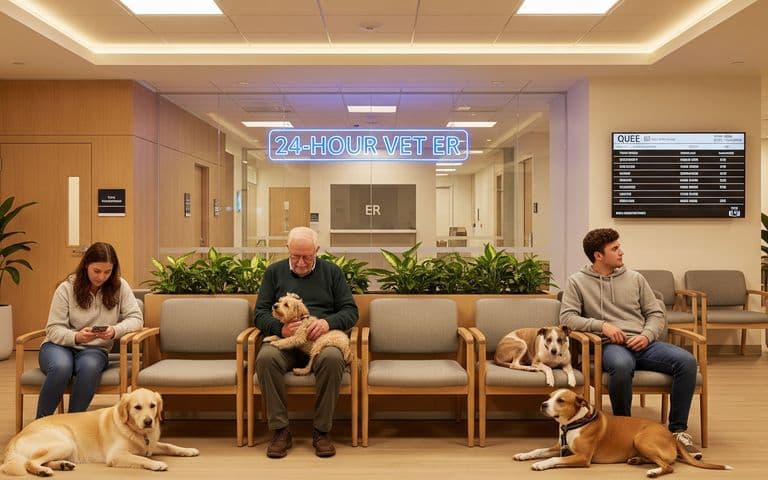
When you arrive at a 24-hour emergency room, cases are prioritized by medical urgency, not by arrival time. Understanding this process can significantly reduce the anxiety of a long wait when your pet appears to be suffering but is clinically stable.
Emergency veterinary services include immediate triage and examination to identify health issues in patients, and many hospitals provide walk-in urgent care services, meaning no appointment is necessary for urgent care.
Life-threatening (immediate): Pets with respiratory distress, active seizures, major hemorrhage, or cardiovascular collapse are moved to the treatment area immediately upon arrival.
Urgent (assessed quickly): Pets that are stable but in significant pain or at documented risk of deteriorating, such as a suspected broken limb, persistent vomiting, or a known toxin ingestion, are prioritized within the first assessment group.
Non-urgent (may wait): Minor conditions such as ear infections, small lacerations, or mild GI upset that can safely wait until higher-acuity cases are stabilized.
A pet that is sitting quietly in the waiting room may still be in significant distress, particularly if pain is being suppressed by shock or neurological dysfunction. If your pet’s condition appears to be worsening during a wait, inform the front desk immediately.
Final Thoughts and How Vetmodo Can Help
A pet emergency is one of the most disorienting experiences an owner can face. The research is clear that owner knowledge and perceptions of urgency are among the most important determinants of timely veterinary care. By arriving prepared with your pet’s records, a clear account of what happened, and an understanding of the triage and financial processes, you allow the emergency team to focus their full energy on what matters most.
Discover the nearest emergency hospital usingVetmodo.com or explore tips for pet safety and preparation to ensure you are ready for any veterinary emergency.
Emergency/Urgent Care
My Dog is Vomiting: When is it an Emergency? A Triage Guide
Vomiting is one of the most common reasons dogs are brought to a veterinary clinic, and one of the hardest for owners to triage at home. This guide covers the warning signs that cannot wait, the presentations that are safe to monitor, and the single most important rule: when in doubt, always contact a veterinarian rather than waiting to see what happens.